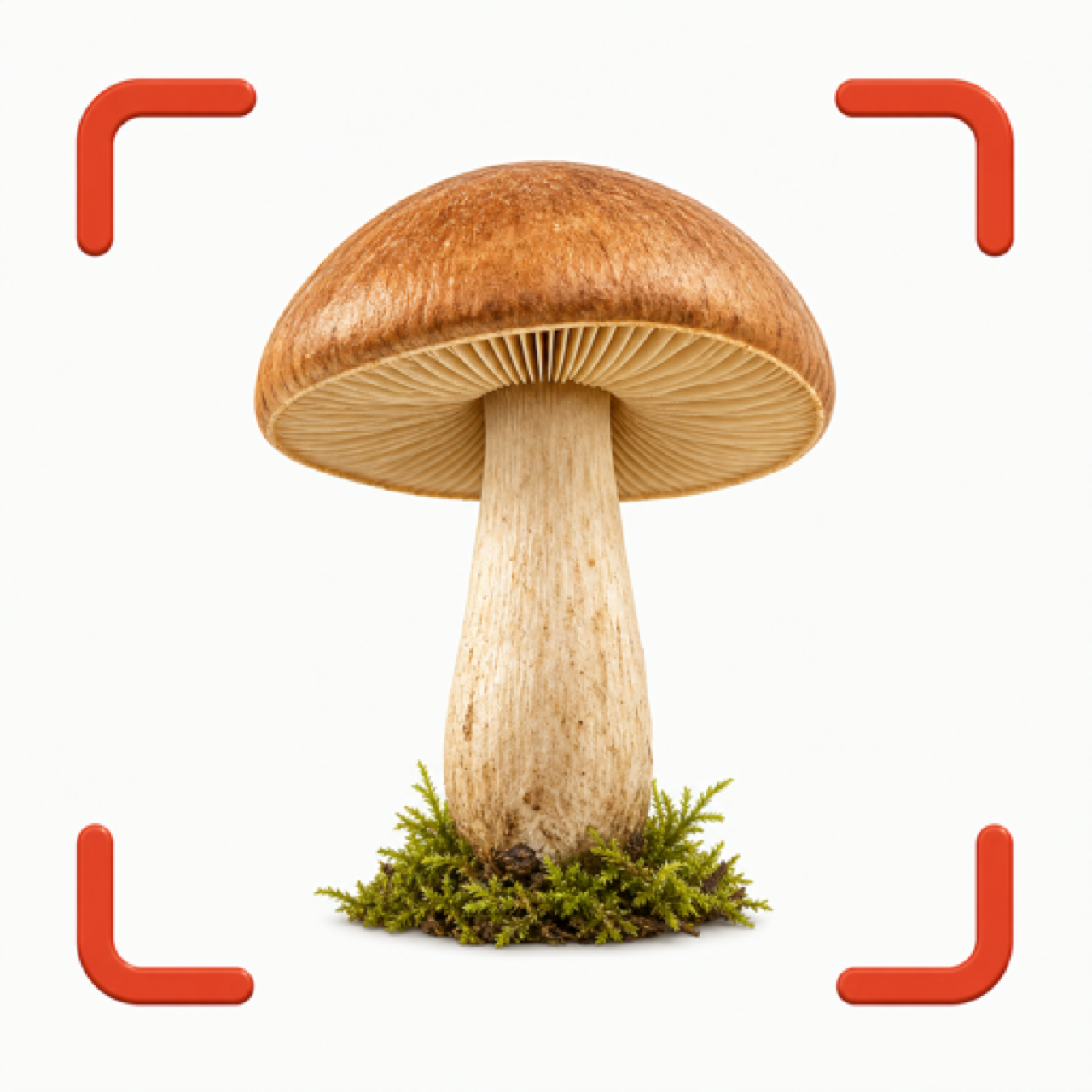
How to identify mushrooms in the wild
Learn the key morphological features — cap, gills, spore print, and stem — that naturalists use to identify fungi by sight.
Start with the cap and gill structure
The pileus, or cap, is the most immediately visible part of a mushroom, but shape alone is rarely enough to reach a confident identification. A skilled naturalist examines the cap surface texture — dry, viscid, or slimy; smooth, scaly, or fibrous — alongside colour, which often shifts as the fruiting body ages or dries. Below the cap, the gill arrangement provides critical data: are they attached to the stem, running down it, or free? Are they crowded, widely spaced, or forking? Gill colour at maturity matters too, because it reflects spore pigment. These observations together narrow a find from a broad family down to a genus, setting up the next steps of identification.
Taking a spore print
A spore print is one of the most reliable macro-level tools in fungal identification. Remove the cap and place it gill-side down on a piece of paper — use white and black halves to capture both light and dark spore colours. Leave it for one to four hours, then carefully lift the cap to reveal the print. Spore colour ranges from white and cream through pink, purple-brown, and black, and this single character can immediately confirm or rule out entire families. White spore prints combined with other features place a specimen in a different category than, say, a dark chocolate-brown or rusty-red print. MushroomLens uses your phone camera to observe cap, gill, and stem details and cross-references them with morphological databases to suggest the most likely genus or species — a useful complement to a field spore print.
Stem features and habitat clues
The stipe, or stem, carries its own identification weight. Note whether a ring (annulus) is present — a membranous skirt left by a partial veil as the cap expanded — and whether the base sits in a volva, a cup-like sheath that emerges from the soil. Both features are significant in distinguishing genera. Beyond the mushroom itself, habitat context is part of any rigorous identification. Substrate matters: growing from wood, soil, dung, or another fungus each points in a different direction. The surrounding tree species influence which mycorrhizal partnerships are even possible. Season and geographical region further narrow the probability space. Combining camera-based visual analysis with location and season data is exactly why a smartphone tool adds value: it aggregates context a field guide cannot hold in one page.
FAQ
What is the safest first step in identifying an unknown mushroom?
Document everything before touching. Photograph the cap top and underside, the stem base, the habitat, and any nearby trees. Note the smell and any colour changes when the flesh is cut. This complete record — combined with a spore print — gives any identification tool or expert the maximum information to work with.
Does colour alone reliably separate mushroom species?
No. Colour is useful but notoriously variable: the same species can appear pale in dry conditions and dark when wet, and colour fades in older specimens. Identification requires combining cap, gill, stem, spore print, substrate, and habitat data. Apps like MushroomLens weight multiple visual features simultaneously, which is more reliable than relying on colour alone.
How do I know if a mushroom identification app result is trustworthy?
Look for a confidence score and the specific features the app used to reach its conclusion. A well-designed app like MushroomLens shows you which morphological details drove the match, so you can check those features yourself. A result with a low confidence score or that is based on an image with poor lighting should be treated as a starting hypothesis, not a conclusion.